Tingsha bells offer a uniquely piercing, ethereal resonance that cuts through mental density, making them an essential tool for framing a sound healing session. By understanding their acoustic properties and material composition, practitioners can select meticulously matched pairs that provide unparalleled clarity and space-clearing capabilities.
Tingsha bells, also known as Tibetan cymbals or Kartals, consist of two small cast-metal discs joined by a leather strap. Historically rooted in Vajrayana Buddhist traditions, they were primarily used as a sonic offering and to clear the energy of a space before sacred work. When struck together, they produce a shimmeringly pure fundamental tone with very rapidly extinguishing lower overtones. Their distinct acoustic signature typically falls in the high-frequency range of 2,000 to 4,000 Hz, a bandwidth highly effective at clearing accumulated mental density and awakening awareness.
Because their sound is simultaneously calming and sharply awakening, I frequently rely on Tingsha to delineate the boundaries of a sound meditation. They are perfect for signaling the beginning of a ritual or gently anchoring a client's awareness back to the physical room at the close of a session.
When choosing a set of Tingsha for professional use, acoustic harmony is critical. Here is how I test for a perfectly matched pair:
Instead of striking the cymbals against each other, suspend them freely by the strap.
Strike each cymbal individually using a bare wooden mallet.
Listen closely to ensure their fundamental pitches are identical.
Be aware that while this meticulous process guarantees a pure, interference-free tone, testing multiple pairs this way will inevitably test the patience of your instrument vendor.
Generally, larger and thicker Tingsha will produce slightly lower pitches and sustain their vibration for a longer period. However, their acoustic behavior is also deeply dictated by the exact alloy used in the casting process.
Recently, I have been exploring the acoustic possibilities of alternative metals, specifically titanium Tingsha. The pieces I currently use are meticulously crafted by Martin Bläse, a highly respected maker known for his exquisite titanium gongs. These modern instruments offer a remarkably clean, crystalline sustain that provides a fascinating contrast to traditional bronze alloys. Here they are!
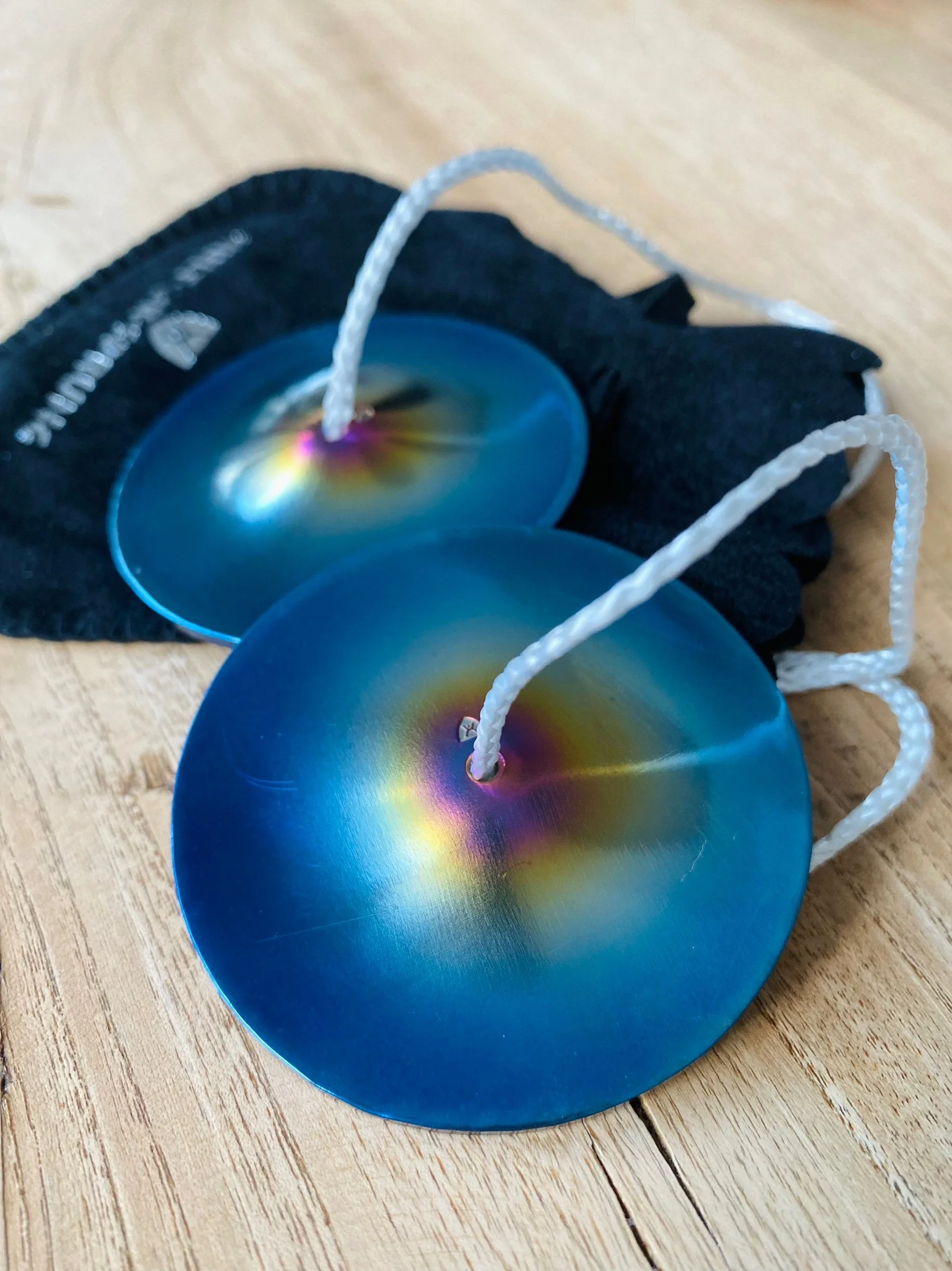
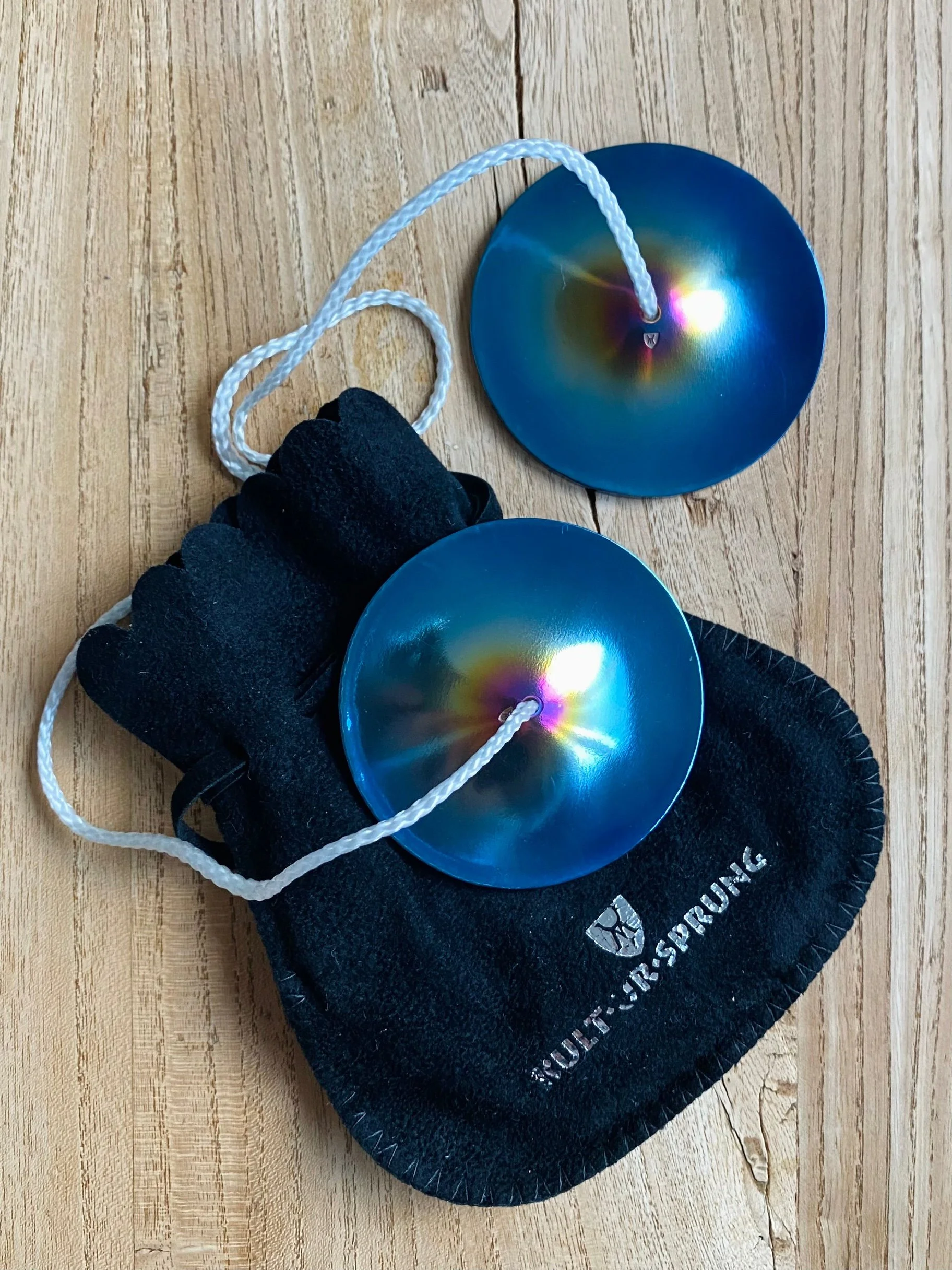
They are very small, but their sound is incredible: 3,520 Hz and a very good sustain. Let’s also listen to them compared to commercial brass tingsha: