True binaural beats are a specific neurological acoustic phenomenon, not just a broad genre of relaxing ambient music. By isolating two slightly detuned frequencies in each ear, we can synthesize a sub-audible pulse that gently entrains our brainwaves into profound states of relaxation.
A lot has been written and said about binaural beats recently across the sound healing community. However, when browsing major streaming platforms, you will often find the word used merely to categorize a genre of relaxing music rather than describing compositions actually built around this specific acoustic mechanism. This can be quite confusing for practitioners and listeners alike. I want to use this post to explain the physics behind binaural beats and allow you to experience them in their purest, unadulterated form.
Binaural beats are created when two tones are intentionally detuned from each other by a small, specific amount. For example, if we play one sound at a frequency of 315 Hz and another at 325 Hz simultaneously, these two tones acoustically interfere with one another. This interference generates a third oscillation with a frequency equal to the exact difference between the original two—in our case, 10 Hz. This resulting frequency is significantly lower than the original tones, leading us to ask whether a 10 Hz sound is even audible.
The short answer is no, at least not in the traditional sense, as the human auditory system only perceives sounds between approximately 20 Hz and 20,000 Hz.
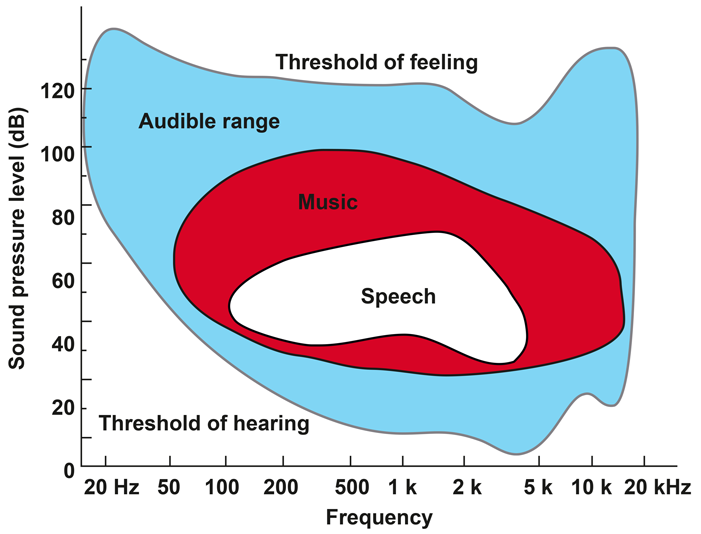
Range of audible frequencies (for human beings).
While our ears cannot detect a 10 Hz frequency as a physical acoustic sound, our nervous system certainly perceives its rhythmic pulse. Frequencies in the range of 0.1 to 30 Hz correspond directly to our natural brain waves. Since no acoustic instrument can naturally project a sound that low, we generate it inside the mind by combining two adjacent frequencies.
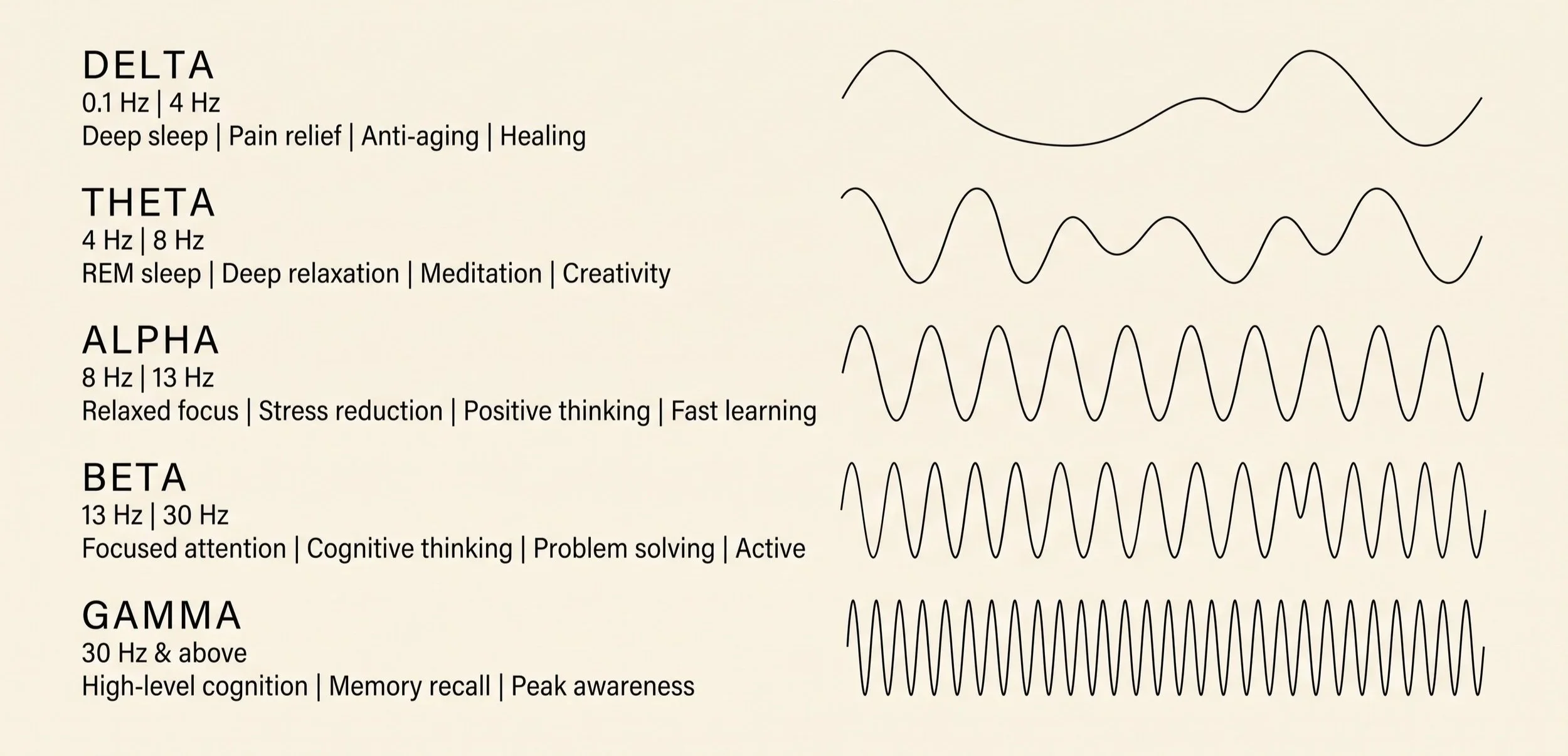
Brain waves and their frequencies
In essence, utilizing binaural beats allows us to synthesize a pulse that synchronizes with our brainwave frequencies, effectively entraining the brain into highly desirable states of deep meditation. Let’s try to build a binaural beat together using two singing bowls. First, I will let you listen to their pure, isolated sounds one by one. Bowl one has a frequency of 137.7 Hz, and bowl two resonates at 147.7 Hz. Please use headphones 🎧 !
To experience the true neurological effect, please put on your headphones 🎧 right now. I have combined the two recordings so that bowl one plays exclusively through your right ear, and bowl two plays exclusively through your left ear.
As you pay attention to the sound, you should clearly perceive a rhythmic oscillation or pulse beneath the main tones, which is the binaural beat itself. I find this phenomenon deeply fascinating because the rhythmic pulsing you hear is not actually a physical sound in the room. It is an auditory illusion created entirely by your brain bridging the gap between your left and right ears and gently guiding your mind into a state of profound peace.