In sound healing, we utilize the acoustic principles of consonance and dissonance to gently guide the brain into profound states of relaxation through a process called entrainment. By understanding how different singing bowls interact, we can intentionally craft powerful cycles of tension and release that facilitate deep healing.
When the human brain is exposed to consistent rhythmic auditory stimuli, its electrical activity naturally begins to synchronize with that rhythm. This acoustic connection allows us to use our singing bowls to gradually shift a listener's baseline emotional state. We achieve this profound shift through a deliberate alternation of harmonious and clashing sounds that eventually dissolve into silence.
To build interesting sequences, we must first understand the physical impact of consonance and dissonance. Two singing bowls are considered consonant when their frequencies align smoothly, producing feelings of deep peace, harmony, and release. Conversely, dissonant bowls produce frequencies that physically clash in the air, creating auditory tension and unsettling emotional weight.
I have recorded three audio examples for you below so you can distinctly hear perfect consonance, imperfect consonance, and pure dissonance.
It is crucial to understand that genuine antique singing bowls were never forged to align with the modern Western musical scale or rigid equal temperament tuning. Forcing these ancient instruments to adhere strictly to Western notes overlooks their true acoustic nature. Consonance and dissonance are not arbitrary musical rules, but physical realities dictated by how many harmonic overtones two sounds naturally share. When two bowls share a high number of harmonic frequencies, their sound waves constructively interlock to create a sweet, consonant resonance, whereas a lack of shared harmonics creates a grating, dissonant clash.
Using three bowls, you can build a powerful sonic sequence that safely mirrors the nervous system's natural processing of stress. You can start with a soothing harmony, evolve into a dissonant cluster to build tension, and then resolve back into consonance. Guiding a listener through this acoustic journey activates physiological mechanisms that actively flush stress from the mind and body.
Practically speaking, we can identify these physical acoustic relationships when building our bowl sets:
Trust your ears: Strike two bowls together; a smooth, unified hum indicates highly shared harmonics (consonance), while an unsettling sensation reveals a lack of shared overtones (dissonance).
Map fundamental notes: If you know the rough pitches of your bowls, map their relationships based on the table below to find naturally consonant pairs.
Establish perfect consonance: Playing a bowl tuned near C alongside one near G creates a highly stable, perfectly consonant pairing.
Expand expressive capabilities: Adding a third bowl near F or A allows you to introduce deliberate dissonance to your consonant foundations, completing your tension-release cycle.
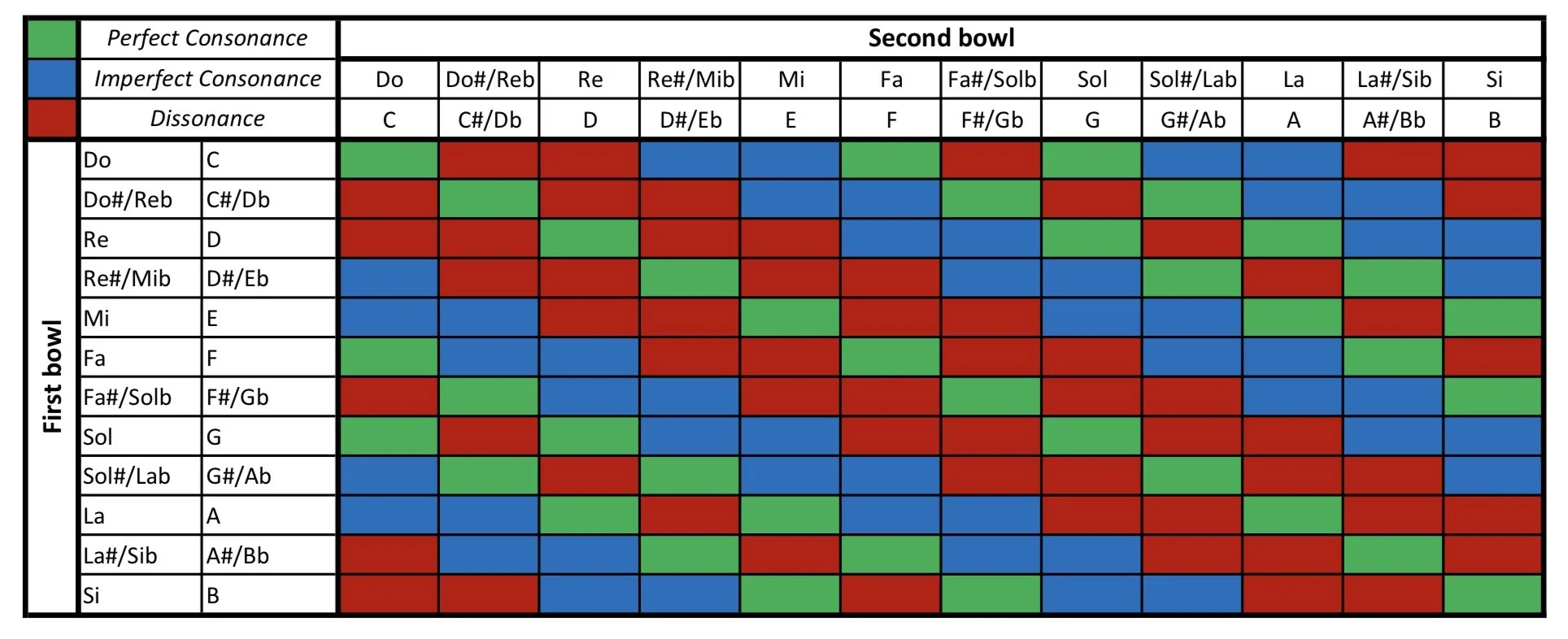
For example, pairing a bowl tuned to C with one tuned to G creates a highly stable, perfectly consonant foundation. Adding a third bowl for example in A expands your expressive palette, allowing you to sculpt a living acoustic narrative because A will create a dissonance with G and an imperfect consonance with C.
Thoughtfully selecting your instruments based on their raw physical acoustics empowers you to craft dynamic, emotionally resonant sessions. Ultimately, our work is not to play rigid musical chords, but to hold a safe acoustic container where human tension can rise, be felt, and gracefully resolve.