Finding your perfect singing bowl is rarely a purely analytical decision, despite the wealth of acoustic data we often rely on. The most profound harmonic matches occur when we bypass the rational intellect and allow an instrument's unique resonance to claim us.
I still remember acquiring my very first singing bowl during a journey to Shangrila in Yunnan. Stepping into a small, softly lit shop, I was presented with four distinct bowls, each possessing a complex acoustic character and a raw, metallic energy. Unable to carry them all home, I listened closely to each one until a specific, heavy piece completely anchored my attention. The bowl I eventually carried back to Beijing in my hand luggage possessed a remarkably long sustain, ringing out for over two minutes from a single, gentle strike.
That extended sustain is a beautiful acoustic teacher for anyone just beginning their sound healing practice. An enduring fundamental tone grants the listener ample time to breathe, ground their physical body, and follow the fading vibration deeply inward. There is no complex sequencing or musical theory required. You simply strike the bowl, close your eyes, and surrender to the physics of the sound wave.
As my collection grew and my ear matured over the years, I realized that the bowl I had acquired wasn’t particularly valuable, and my selection process became increasingly exhausting. I began rigorously analyzing every potential instrument based on precise fundamental frequencies, overlapping harmonics, historical dating, and specific metallurgical composition. Yet, despite mapping all this dense acoustic data, I realized that I still loved that very first bowl. My final choice when selecting other instruments always defaulted to those that created an immediate, visceral emotional response in my chest.
Today, when friends and students ask me how to find singing bowls for them, I guide them toward a much more intuitive framework. We first establish practical budget boundaries so that financial anxiety does not cloud the listening experience or create unnecessary tension in the body. Once that is done, I ask them to close their eyes, strike the bowl, and track how the physical vibration moves through their nervous system.
Does this specific resonance speak to your heart, and do you want to carry this exact sound into your daily life or to share it with others? By releasing the absolute need for acoustic perfection, we open ourselves up to true healing resonance.
You never really choose a singing bowl through pure logic or musical theory, because every human body acts as a highly sensitive biological receiver for acoustic vibrations. When a bowl truly chooses you, its complex harmonic signature physically interlocks with your unique physiological state, triggering an involuntary release of tension before your conscious mind even registers the note. If you listen closely enough in the silence that follows the strike, your nervous system will recognize its exact acoustic match, and the right instrument will inevitably “choose” you.
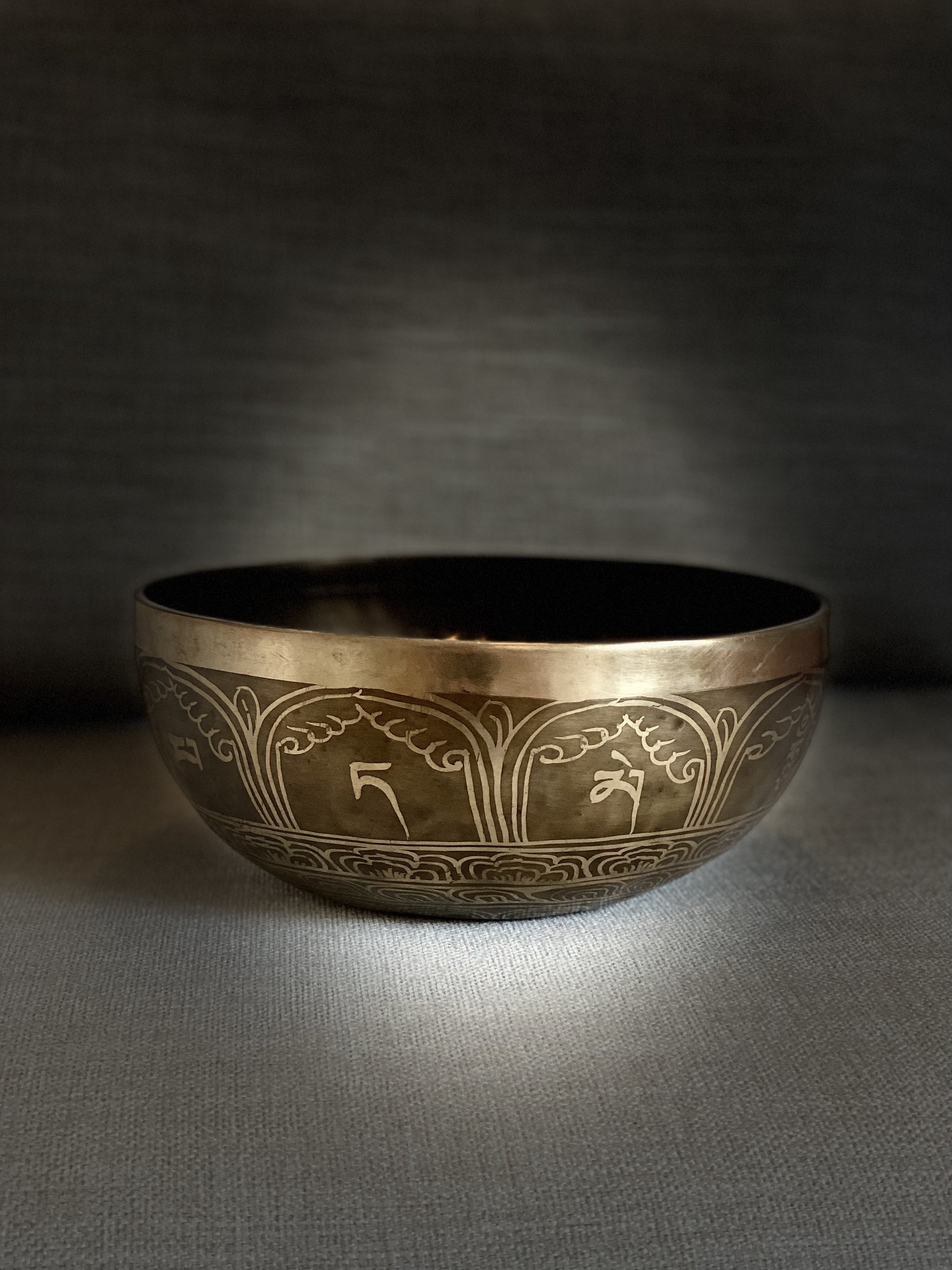
My first singing bowl from a shop in Shangrila, Yunnan, China.