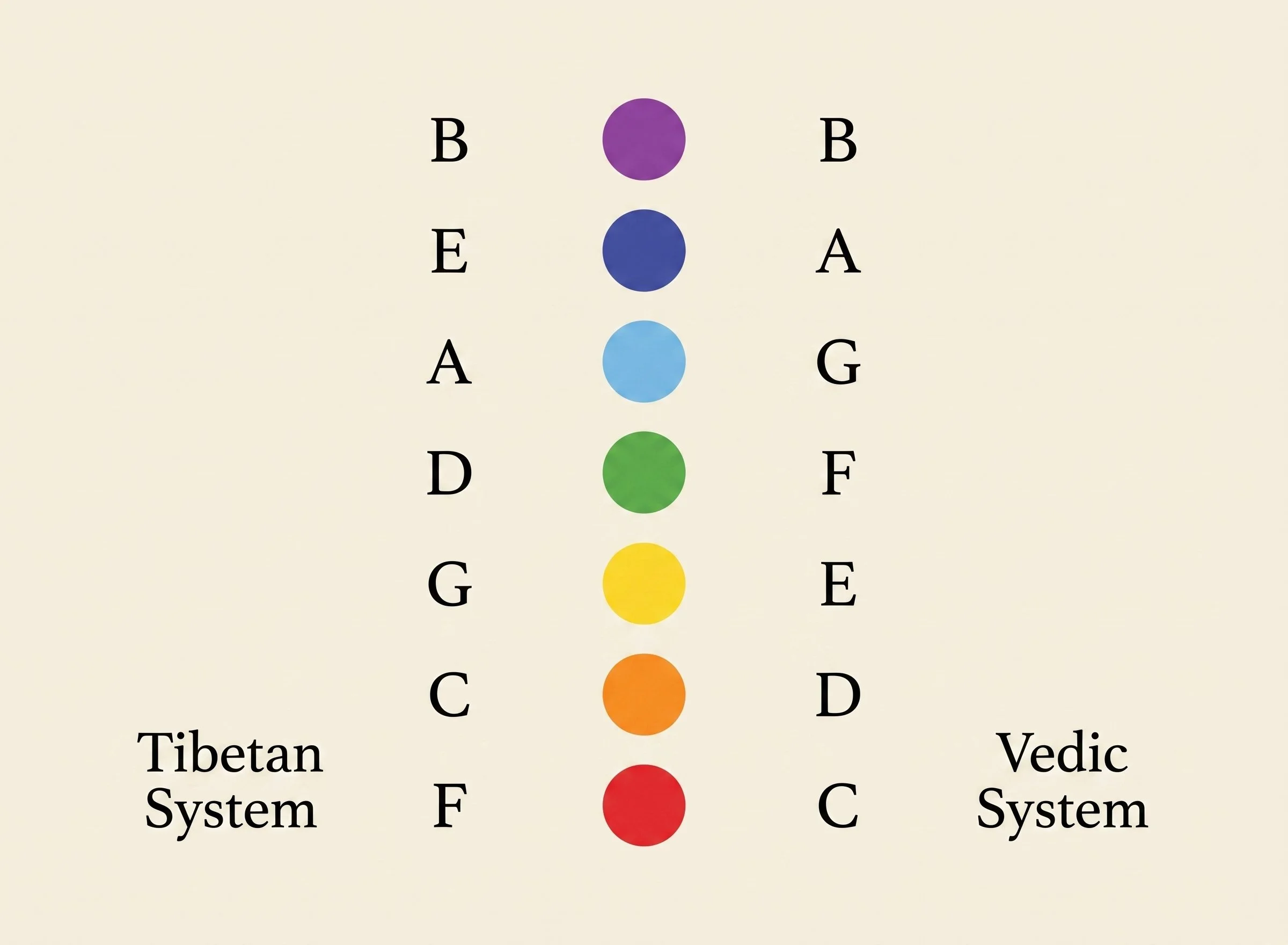
The relationship between Himalayan singing bowls, Western musical notes, and the chakra system is a fascinating but historically complex topic. While many modern systems attempt to link specific pitches to specific energy centers, examining the acoustics and history reveals why these frameworks often fall short.
In the sound healing community, there are many beautiful frameworks used to associate singing bowls with specific chakras, colors, or even planetary frequencies. Practitioners often use these correspondences to guide their sessions, creating a structured map for meditation and energetic alignment. Whether assigning a specific pitch to a corresponding body center or matching a bowl's tone to a planetary orbit, these systems aim to create a sense of harmony. Each approach offers a unique lens through which to experience sound, providing valuable pathways for intention-setting in our work.
However, linking ancient chakras directly to modern Western musical notes presents a profound historical anachronism. The earliest Indian texts detailing the chakra system emerged around 700 BC, while our musical framework of "do-re-mi" was introduced by Guido d'Arezzo much later in the 11th century. Furthermore, antique singing bowls do not naturally align with Western "equal temperament"—the modern tuning system that uniformly divides an octave into twelve artificially equal steps. Forcing these ancient, polyphonic instruments into strict modern pitches ignores their rich, untamed acoustic reality.
Among the modern frameworks, the "Tibetan system" based on the circle of fifths (F-C-G-D-A-E-B) aligns much closer with actual physics and acoustics. Rather than stepping through a dissonant linear scale, this system links the chakras using the musical interval of a perfect fifth. In fact:
Notes a perfect fifth apart naturally share many of the same harmonic overtones.
This shared acoustic resonance creates profound consonance and auditory harmony.
Transitioning between chakras using fifths gently soothes the parasympathetic nervous system, avoiding the jarring tension of linear intervals.
Ultimately, I disagree with the ongoing pursuit of forcing singing bowl frequencies to perfectly match the Western musical system. Their profound healing potential stems from their complex, multi-layered harmonics rather than a single, isolated note. To date, I have not found a truly compelling, historically accurate framework that definitively links these instruments directly to the chakras. I encourage practitioners to trust their ears and let the raw, complex resonance of each unique bowl guide their sessions instead.