Code: N173F4B5I
Note:
There is an enriching debate among top Himalayan antiquities experts regarding the true origin of the Naga shape. Leading experts note that these pedestal vessels were primarily forged as elite offering bowls rather than purpose-built musical instruments. However, because they were crafted using highest-grade resonant bell-metal bronze, they evolve beautifully into singing instruments.
While Naga bowls in my experience never possess the "exceptional" acoustic attributes of other singing bowl families, I find that their unique architecture and presence makes them compelling. This specific piece has been integrated into my own professional sound work, valued for the distinct, focused energetic tension it brings to a room.
Classification & Form
Type: Naga (Chalice) Bowl.
Form Profile: Distinguished by its attached pedestal base, this vessel breaks from traditional Himalayan bowl shapes to offer a chalice-like architecture historically used for ceremonial offerings.
Musical Signature & Acoustics
Fundamental Pitch: F4 (350 Hz), providing a clear, anchoring mid-register foundation.
Harmonic Overtones: A bright, sustained B5 (973 Hz) upper frequency.
Acoustic Presence: The interval between F4 and B5 inherently carries a complex, slightly dissonant acoustic relationship. Rather than feeling jarring, this interplay creates a beautiful, gentle tension. It is a remarkably soothing sound that subtly challenges the ear, keeping the mind anchored and present during sound work rather than allowing it to passively drift.
Physical Specifications
Dimensions: 17.3 cm diameter.
Weight: 1.21 kg.
Architecture: The substantial weight for its size is concentrated in the dense walls and the solid base, providing the necessary mass to sustain its captivating dual tone.
Patina & Surface Characteristics
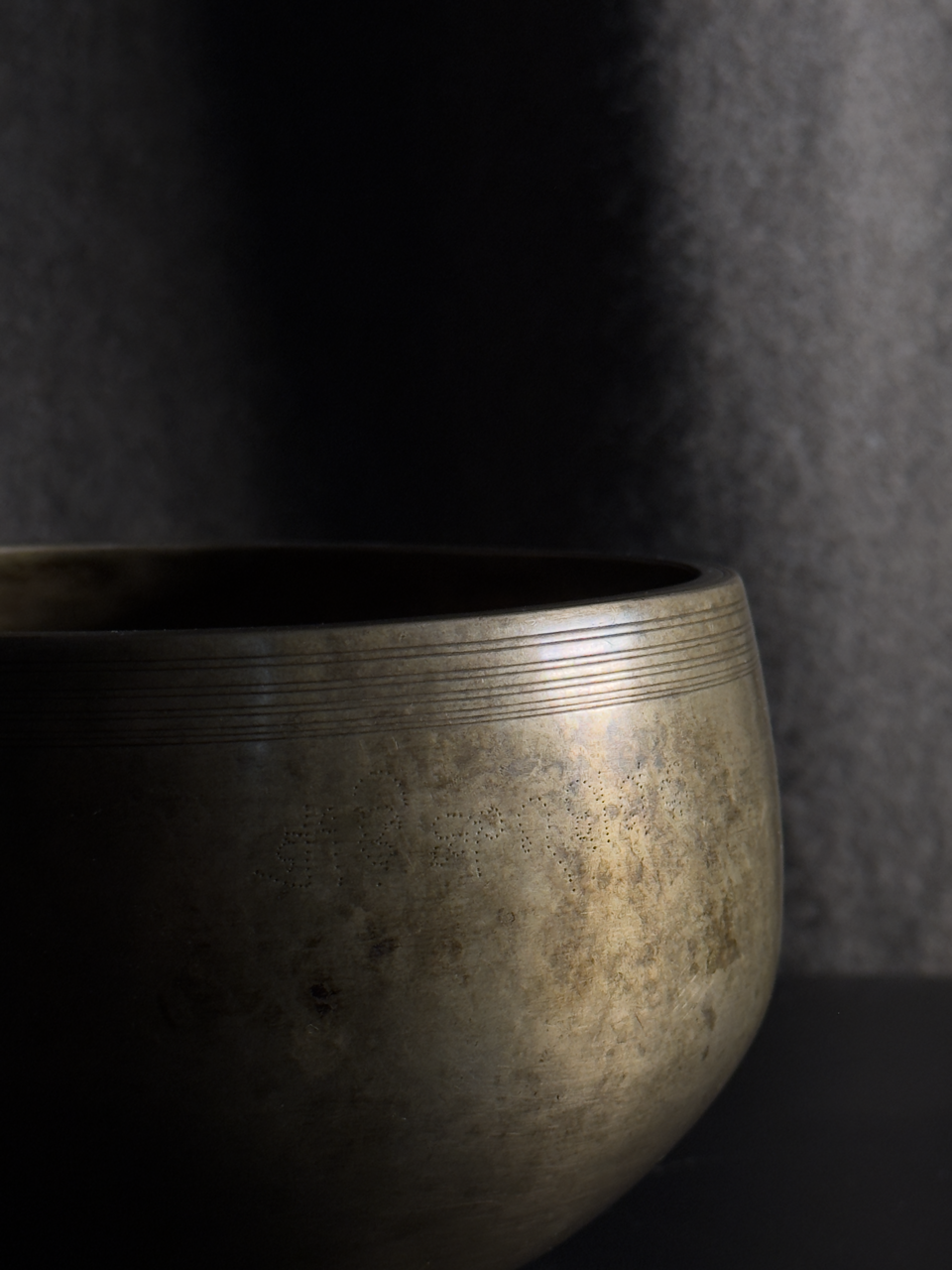
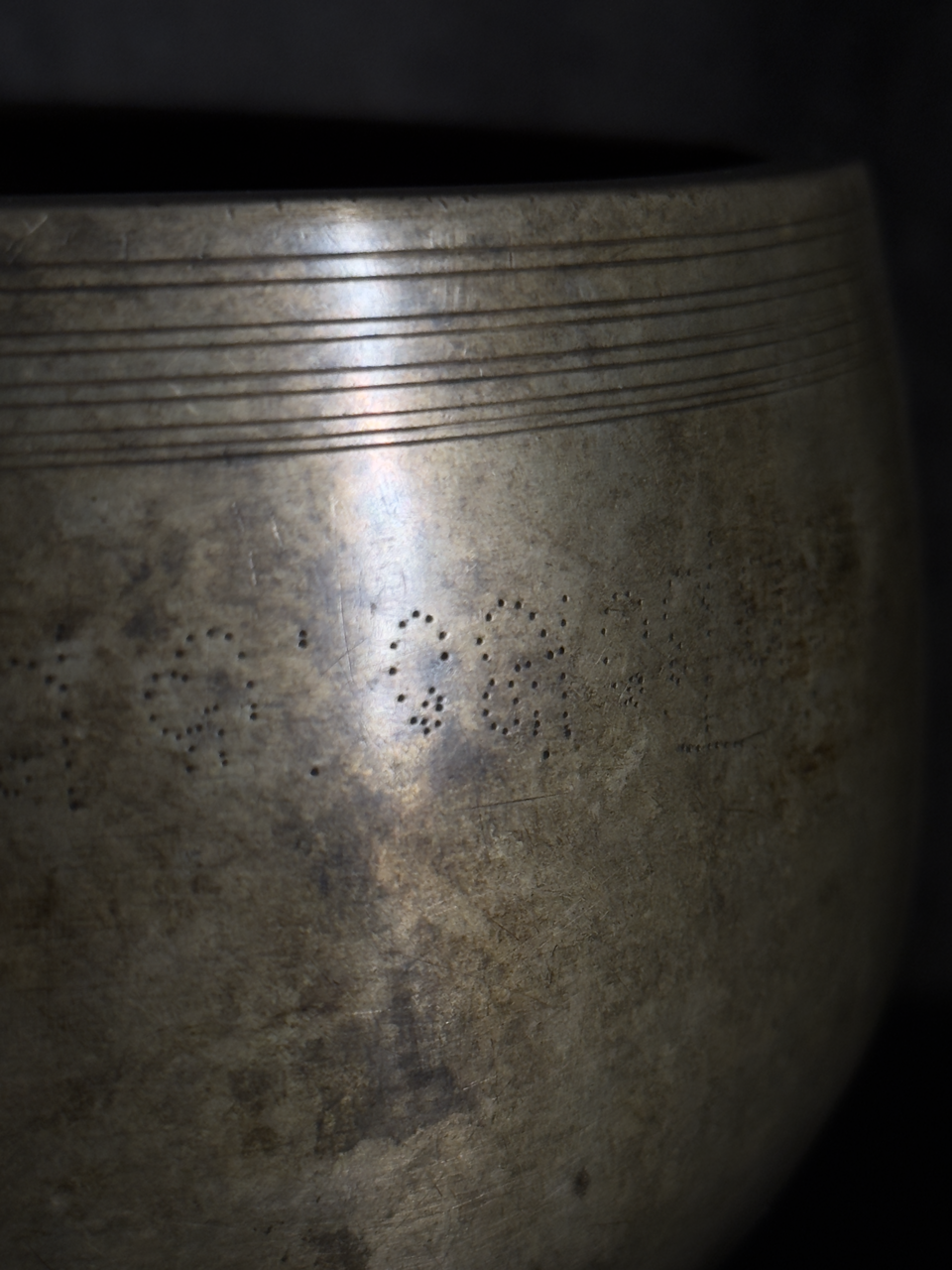
The exterior features a long, beautifully preserved dotted inscription, adding a deep sense of mystery and character to its lineage.
Rhythmic, incised bands circle the upper wall just below the rim, contrasting elegantly with the smooth, aged golden-bronze patina of the lower basin.
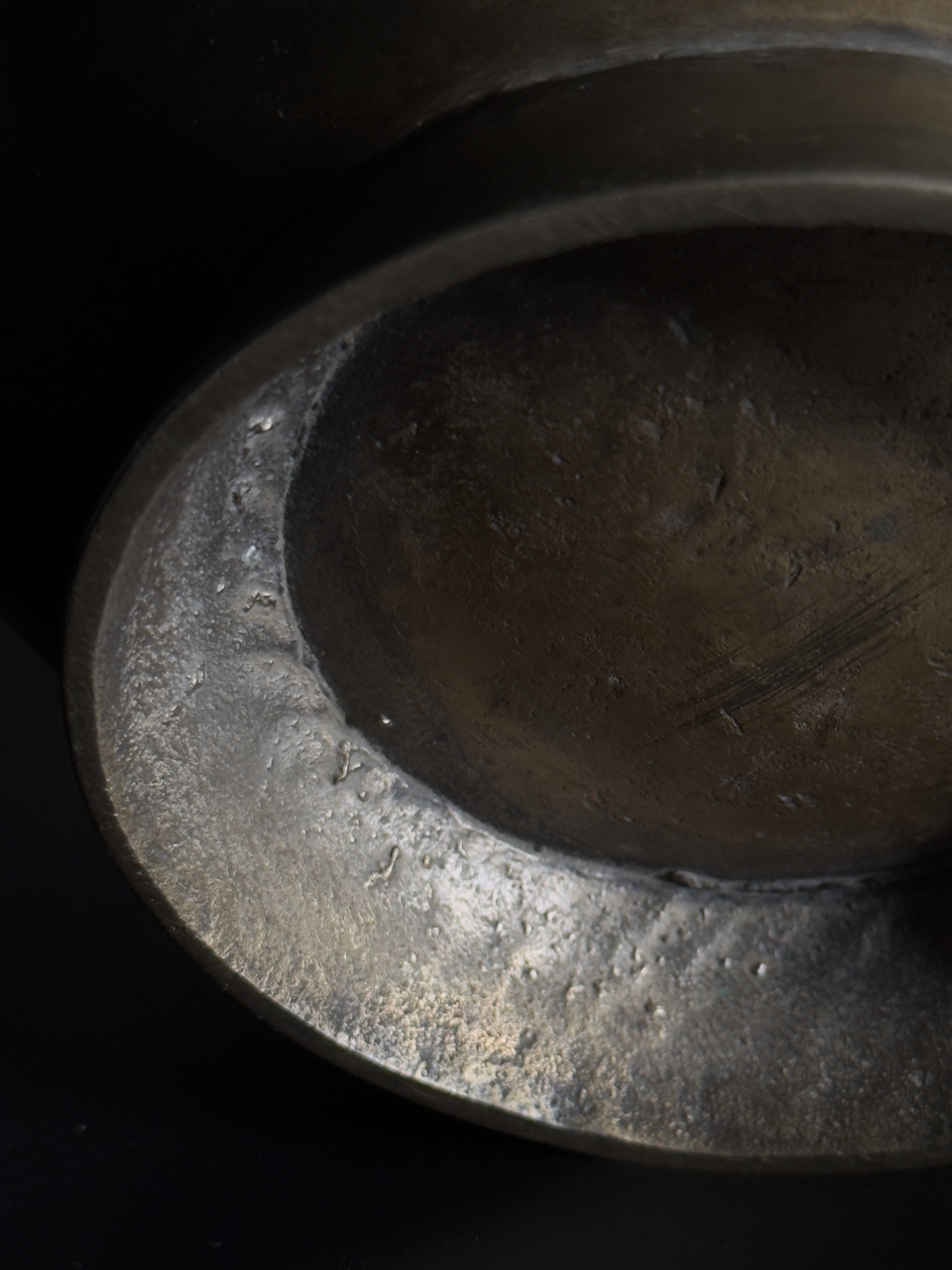
The connection point between the basin and the pedestal reveals an exceptionally clean example of traditional metallurgical fusion.
Archival Notes: The Art of Pressure Welding
The pedestal was attached using an ancient technique known as pressure welding, sometimes referred to as forge welding.
Instead of using modern soldering or filler metals, the artisan heated both the bowl base and the pedestal to near-melting temperatures before hammering them together under immense, focused pressure.
This archaic method effectively fuses the two separate pieces of bronze into a single, seamless structure.
Because no foreign metals are introduced into the joint, the acoustic vibrations are able to travel cleanly and purely through the entire instrument without damping or interruption.